
Its a truism that personal experience is present in any artists work, but it was surprising to discover my pivotal event the birth of my sister, or rather that the spaces and actions surrounding the birth are the root of my artistic doctrine. A distrust of mass experience, commiseration with inanimate objects, the creation of personal space in public environments, and the way these incorporeal barriers are recognized is at the core of my practice.
First, some back story. Molly was born with severe heart defects. It took a group of surgeons at a renowned medical center eight months to figure out and repair. We lived outside Chicago with no other family nearby. It shifted our lives. Hours in hospital waiting rooms, careening from one medical crisis to another. School, friends, and everything else necessarily slipped to the background. I was seven.
Carving discrete spaces from communal places became crucial. A waiting room outside the Northwestern NICU was the first foray into this experience. I would arrange coats and things over the edge of lines of chairs and hide. My family didnt talk much then, so I would escape into L. Frank Baums Oz stories where landscapes were described in terms so vivid they became tangible. Sometimes other families would come and go, but it was always our space. A place for my family, where all others were just company. I would sit, staring at the bright bubbling fish tank against the east wall; weaving neon colored nylon circles together into a chain, and letting my mind wander beyond the walls. I watched and wove constantly for 8 months, making a chain that could reach across the room and back 9 times.
After my sister was declared well enough and came home, we tried to assume an air of suburban normalcy. Returning to school felt unnatural. My family had become the town spectacle. Well wishing parents, teachers and classmates would seek me out in the hallways or at recess, put their arms around me, and offer some platitude, then press for dirt on my family and the sensation that was Mollys illness. People would prod for the smallest bit of gossip, then run to tell others. It felt odd and powerful and lonely.
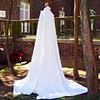
Individually people were relatable, but groups tended to follow a singular mentality directed by whoever was loudest. We were the town pariahs and we no longer cared; it became Us versus Them. I gradually stopped participating in the organized games or playing with groups just to avoid the pitying questions, and started building forts for one. Bending branches of bushes and weaving them together to make living walls and hidden cocoons. Digging out snow tunnels just big enough to lie in. When a structure was complete I would just exist in the space, listening to the muffled sounds of my peers around me, reveling in the barrier that let me see and hear them, but not be seen or heard. Yayoi Kusamas Fireflies on the Water is the only art piece I have ever encountered that brings about the same special awareness. It is that feeling of giddy control and success that I am striving to recapture with every piece I make.
Eventually I learned to fake it out of social necessity. I built a shell of normalcy around myself and my family. I learned to watch and listen the people around me to dissect their behavior. I looked out for the conventional and then did my best to emulate it. How things were done, or whats actually happening never crosses anyones mind. In general the surface is all anyone pays attention to.
Art is the only discipline I have found that forces people to look deeper. I struggle between my desire to be open; leaving my thoughts and work bare for everyone to feel for themselves, and my impulse to cover up the vulnerable and paint a thick glossy layer of normal over my life and work.
Each artwork is self-encapsulated. Recurring feelings I have on something I am missing or have failed at is the root. I both illustrate and hide that singular feeling in every form. The labor over its creation is obsessive, intensive, and consuming. A kind of forced involvement to sacrifice myself to the piece itself. I approach the work from two sides of thought. My labor and the central idea are always personal, but I link to a societal feeling as well. I try to make my failings part of the general human condition as a way to relieve the pressure from my own shoulders and diffuse them among the public.
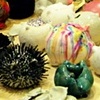
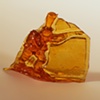
My pigs articulate my struggle with finances, especially with the symbolism of money in the art world. None function as piggy banks, either because of a lack of slit or by the creation of a ramp that runs from the tope hole through one placed in the rear of the pig. Most are made from paper porcelain, a process of adding fiber to wet slip to make the finished product as thin and translucent as possible. Their fragility is masked with layers of surface treatment that mimics art movements and deco styles.
This series of 40 pigs works as a collective and individual pieces. Each one a relic of the project evolution, becoming less humorous and playful as it progressed and their execution becomes increasingly violent and losing control. The skin of the wet clay is repeatedly breeched by hand or object, and grows increasingly malformed. A video that accompanied their installation shows my youngest brother with a porcelain pig he had bonded with. He destroys the pig, shattering it with a hammer while his voice and the voice of my youngest sister discuss their relationship formed with the pigs and each determine whether or not to break the object for the money sealed inside.
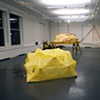
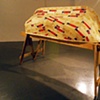
While faced with a health scare and dealing with personal image issues I focused on civic health concerns and resolved the two by building a six foot boat out of wooden Clementine crates. The boats ribbing is based on the female hipbone structure and lined with waterproofing fabric. The screws that hold together the Clementine box-skin pierce and void the lining in a decorative but violent way. The surface of the boat undulates over the changing width and depth of the ribs giving it an odd bulging form while the pattern of the screw heads suggest something between battleship rivets and a bejeweled, effect.
Overwrought surface, shells of texture built to mimic other forms, and accessible personal scale are constants in my practice. I am still working through how my art relating creates individual experience. Controlling space scale and content lets me engage viewers one at a time and test them- to see if they can relate to the piece or just reframe it, accepting the duality of my concept and choosing whether to see the mass definition, or search for the personal amidst the form and surface. The final test is compassion for the piece. Do the viewers feel for the images or forms or just accept them as space occupiers? Finding this resolution is my goal as I begin to explore more direct interpretations of personal and public spaces. Looking to artists such as Do-ho Suh for inspiration for thoughts on public space and use of the multiple, or Anne Tyng and her consistent marriage of function with organic geometry in space will direct my focus as I address incorporeal spatial barriers.

